← All projects
Fortune 500 Life Sciences · $25B+ Revenue

Enterprise asset lifecycle management, built production-grade.

A full asset lifecycle platform for a Fortune 500 life sciences company: 26,000+ assets, six sites, role-based access on every request, and a complete audit trail. Designed, built, and shipped by one person with an AI-native delivery method.
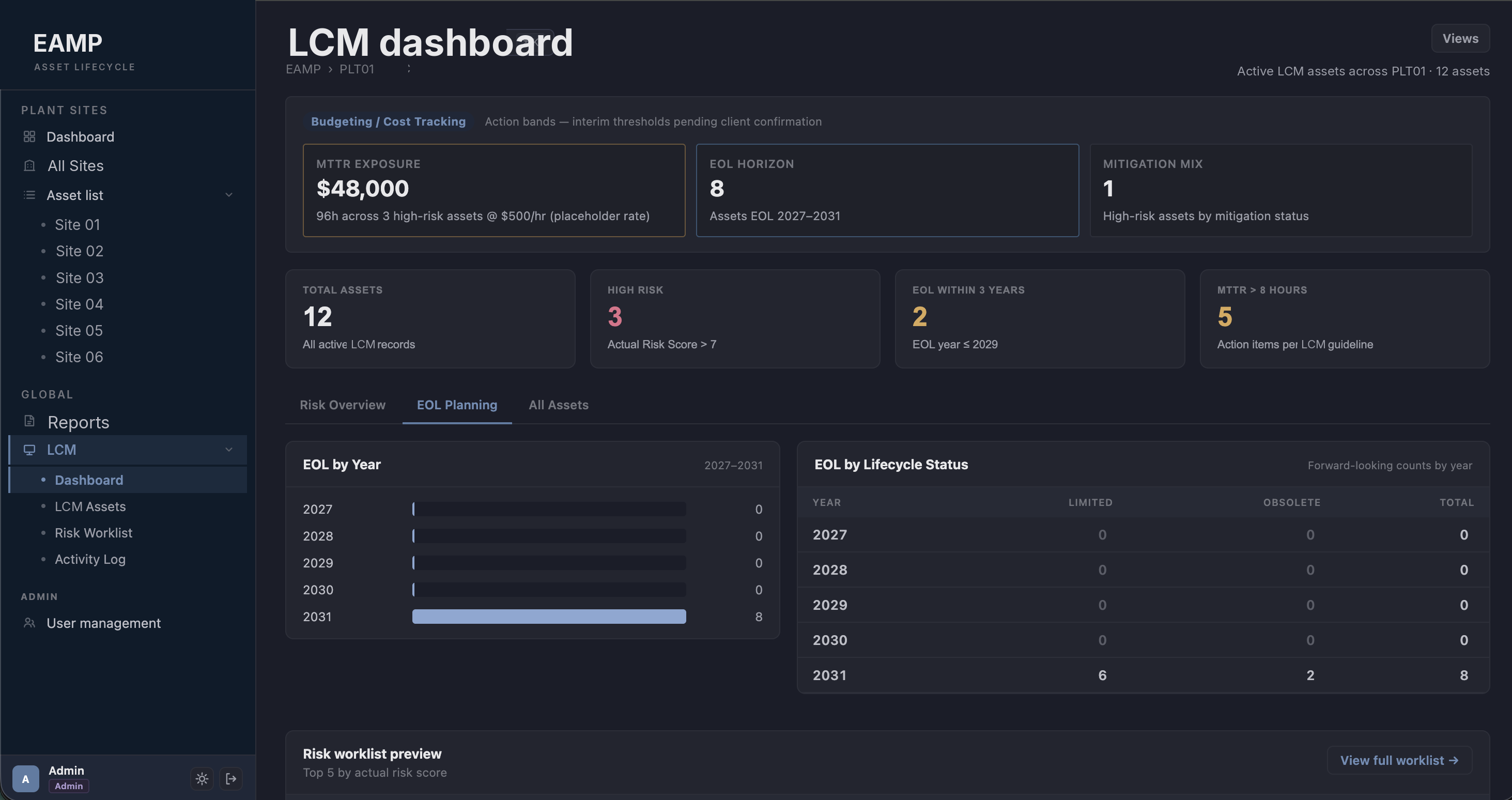
EAMP asset lifecycle dashboard: risk exposure, EOL planning, and mitigation tracking across plant sites.
26,000+
Assets under management across six manufacturing and research sites
48
User roster with per-request role, site, and module authorization
0
Client identifiers in the codebase, verified by automated audit on every push
1
Builder
The Problem

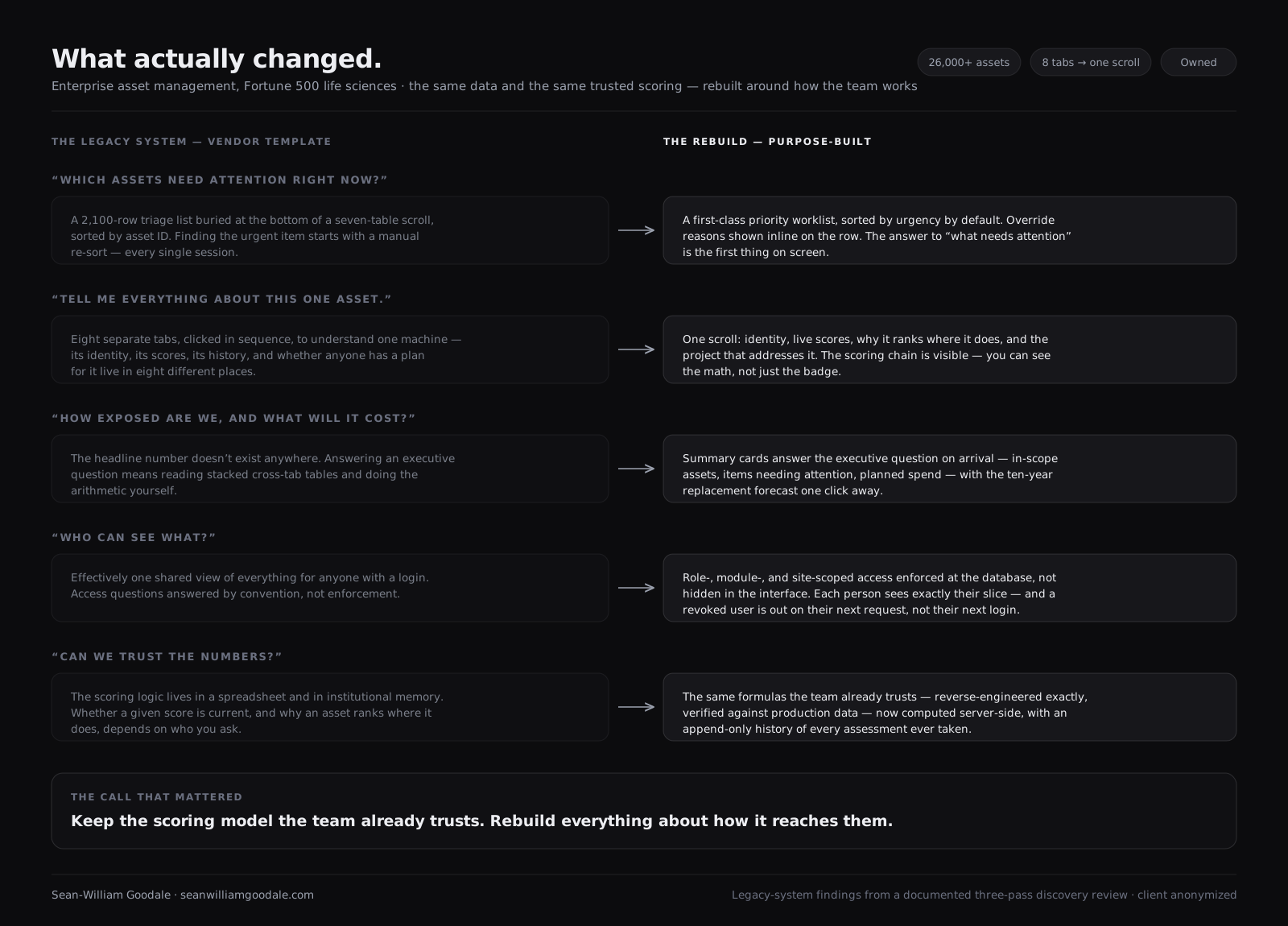
Replacement decisions worth millions, made from files.

Asset lifecycle assessments lived in spreadsheets. Risk scoring, end-of-life planning, and mitigation status had no shared operating picture across sites.

The Product

Five views of the same register.

Click any view to open it full size.

EAMP dashboard: risk exposure, cost, and EOL horizon in one view
DashboardRisk, cost exposure, and EOL horizon in one view. MTTR exposure is priced, not guessed.
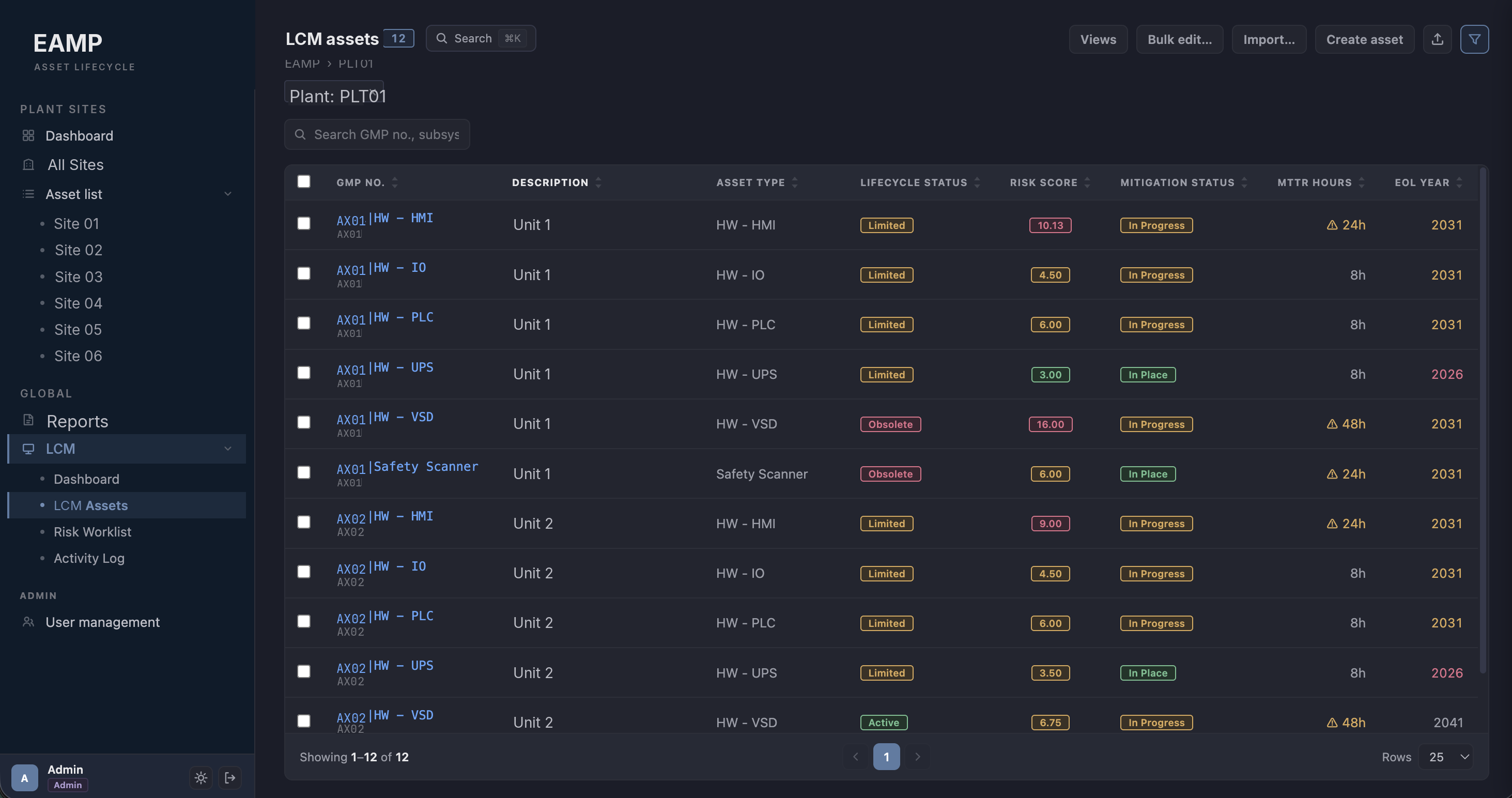
EAMP asset registry: lifecycle status, risk score, mitigation state, and EOL year per asset
Asset registryThe full registry at 26,000+ asset scale: lifecycle status, risk score, mitigation state, and EOL year per asset.
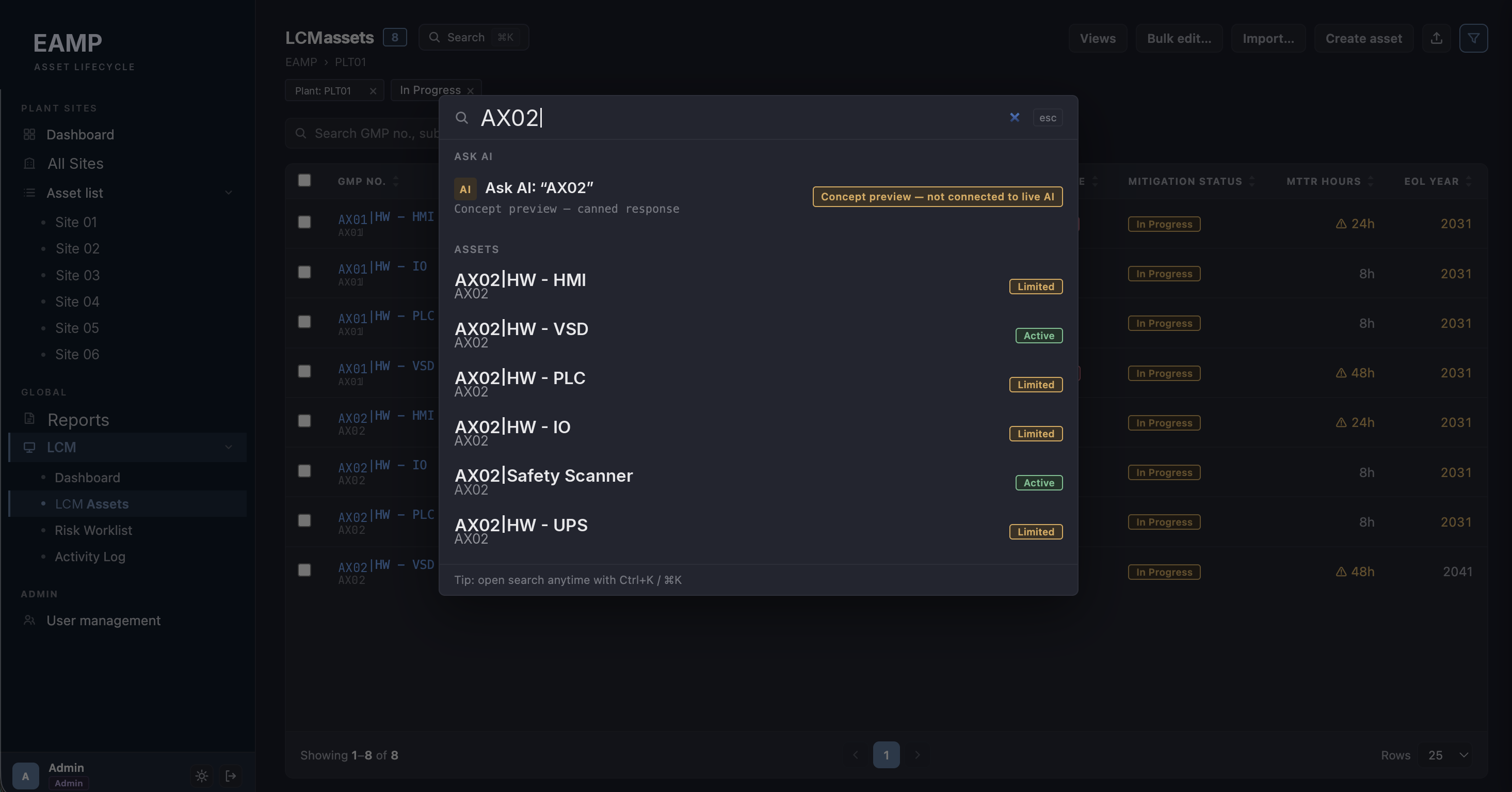
EAMP command-palette search across the asset registry
SearchCommand-palette search across the entire registry. AI-assisted querying staged behind the client’s governance review.
EAMP risk assessment: probability times impact times mitigation factor
Risk assessmentA transparent risk engine: probability times impact times mitigation factor. Every score traceable to its inputs.
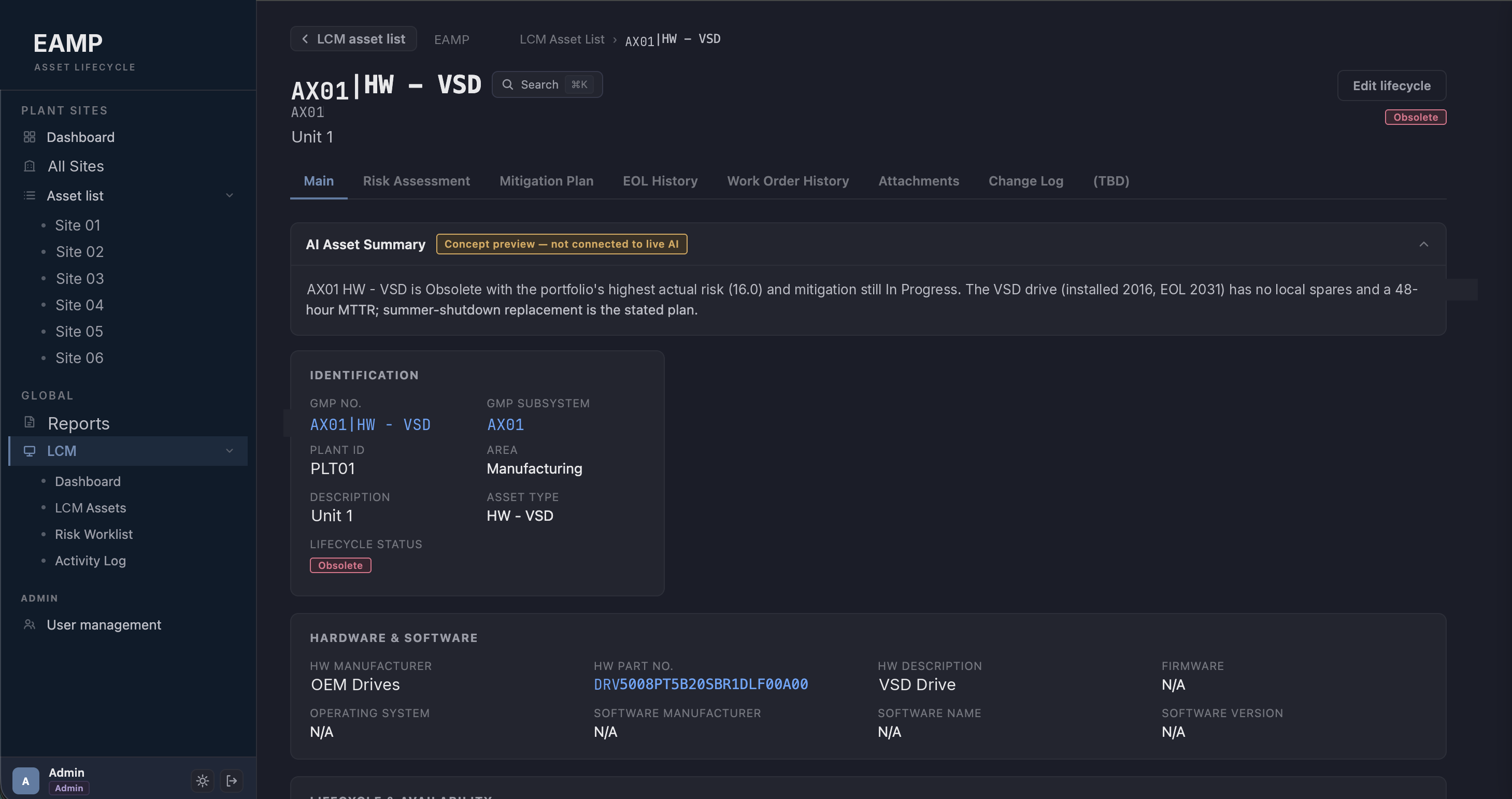
EAMP asset detail: identification, hardware, lifecycle, work orders, attachments, and change log
Asset detailOne record per asset: identification, hardware, lifecycle, work-order history, attachments, and a full change log.
Enterprise Grade

What enterprise-grade actually means.

Six things a $25B+ environment asks for before a system goes anywhere near production.

01
Authorization on every request.
Role, site access, and module access enforced server-side, not hidden in the UI.
02
A complete audit trail.
Every edit captured in an append-only change log with actor, field, and timestamp.
03
Security review ready.
Architecture, security, and AI governance documentation written in the client’s own assessment format, pre-answering their required controls.
04
CI that proves correctness.
Every push runs the build plus a ground-truth verification suite against a seeded database. The gate was proven by deliberately breaking the risk formula and watching it fail.
05
Client data never enters the repository.
Real reference data lives outside git; an automated identifier audit runs before every deploy.
06
Operations documented.
Migration runbooks, backup and restore procedures, support playbook, and UAT scripts shipped alongside the code.
Build notes

The build ran on an AI-native delivery method: a decision register capturing every architectural choice and its rationale, session logs carrying context between working sessions, and a master tracker holding scope against status. Claude Code was the build tool throughout.

The method is what made a platform of this scope tractable for one person. It is also what made the work auditable: the same records that kept the build on course answer a reviewer asking why something was built the way it was.

EAMP from-to transformation diagram